McDonald’s gets millions of applicants every year. The hiring process is simpler than people expect, and that simplicity trips people up.
A lot of job seekers walk in underprepared because they assume fast food hiring is casual. Getting the details right still matters, even for an entry-level crew role.
This one is for students, first-time job seekers, and anyone returning to the workforce after a gap who wants a practical, no-fluff look at what actually happens between application and first shift.
Why McDonald’s Is Still a Smart First Job in 2026
The resume credibility argument is real. Almost every hiring manager on the planet recognizes the golden arches.
Starting your work history with a globally recognized brand, even in a crew role, signals that you can handle structure, customer interaction, and a fast-paced environment.
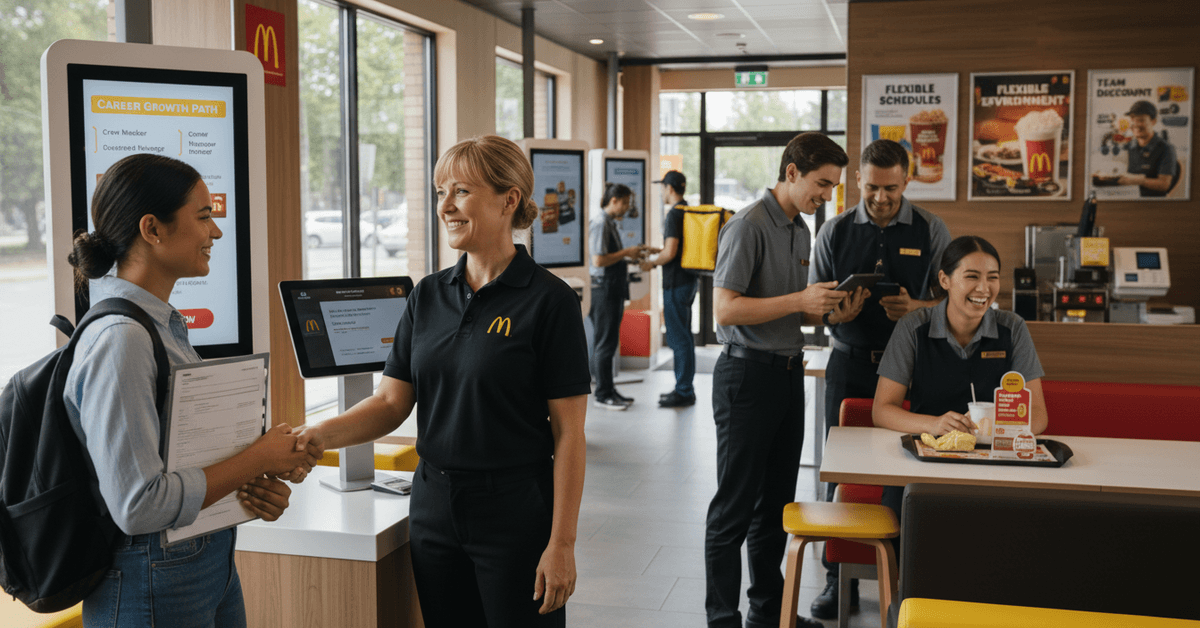
Beyond recognition, flexible scheduling is the actual selling point for most applicants. Shifts that wrap around school schedules or a second job are not just possible at McDonald’s; they are expected and built into how most locations operate.
I think the internal promotion track is underrated. Crew members can move into shift supervisor and assistant manager roles within a year or two, and McDonald’s has documented cases where former crew members ended up in corporate positions.
The practical benefits worth knowing:
- Flexible scheduling for students, parents, and side-hustlers
- Paid training that transfers to other customer service roles
- Employee meal discounts that vary by location and country
- Clear promotion criteria from crew member to supervisor to management
How the McDonald’s Application Process Actually Works
Online Portal vs. Walking In
Two routes exist. The McDonald’s Careers Portal lets you apply to multiple locations at once, track your application status, and sometimes complete initial screening questions before a human even sees your profile.

Walking into a restaurant during a slow period, asking for an application form, and handing over a printed resume still works in many countries. It also creates an instant impression.
A hiring manager who sees a calm, polite, well-dressed person at the counter during a Tuesday afternoon lull is going to remember that face when reviewing applications.
I genuinely disagree with the advice that online applications are always the better route.
For entry-level roles at a physical location, showing up in person during off-peak hours, around 2 to 4 PM on a weekday, gives you a visibility advantage that an online form cannot replicate.
| Application Method | Best For | Watch Out For |
|---|---|---|
| Online Portal | Applying to multiple locations fast | Getting lost in volume; follow up by phone |
| In-Person Visit | Creating a direct impression | Go during non-peak hours, not lunch rush |
| Both Combined | Urgent hiring situations | Confirm with the location which they prefer |
The in-person route works best when a location has an urgent staffing need. Both methods together is not overkill; some stores actively prefer it.
What McDonald’s Is Actually Looking For
Experience is secondary. The qualities that hiring managers cite most often: reliability, availability, and communication.
A candidate who can clearly state their available hours, shows up on time for the interview, and answers questions without hedging will outperform a candidate with a longer resume who is vague about their schedule.
Roles available at most locations include:
- Crew Member (kitchen and front counter)
- Cashier
- Cook
- Shift Supervisor
- Management Trainee
Some locations also hire delivery coordinators and cleaning staff, depending on the country and store format.
The Interview: Shorter Than You Think, More Honest Than You Expect
What the Interview Looks Like
McDonald’s interviews are short. Some candidates report finishing in under 15 minutes. Group interviews happen at some locations; one-on-one conversations with a shift manager are more common.
The questions are straightforward. Expect something about how you would handle a difficult customer, how you manage a busy shift, and why you want to work at this specific location. A specific answer beats a generic one every time.
What Interviewers Are Actually Listening For
Managers at McDonald’s are not screening for perfection. They are screening for self-awareness and coachability.
Saying something like “I haven’t worked in a kitchen before, but I pick up systems quickly” lands better than overclaiming experience.
A hiring manager who trains new staff weekly can tell within two minutes whether someone is honest about what they know and don’t know.
Common interview topics:
- Teamwork examples from school, sports, or previous work
- How you handle pressure or time conflicts
- Availability across days and shifts
- Specific reason for choosing this location
- Comfort with rotating or weekend shifts
Waiting a few days to a week for a callback is normal. If a location is urgently hiring, offers can come the same day.
Documents, Age Requirements, and Regional Differences
What to Bring
McDonald’s asks for a valid government-issued ID at a minimum. Depending on the country, additional documents may include:
- Proof of work eligibility or residency
- A student card with supplementary documentation
- References (more common for supervisor-level roles)
- Proof of age, since requirements differ by country (often 16+, sometimes 18+)
A printed resume is optional for crew-level applications but worth bringing. It signals preparation and gives the manager something concrete to reference.
Age and Language Rules Vary More Than People Realize
The US, EU, and Southeast Asian markets all set different minimum age thresholds. Language requirements also differ. Some locations in multilingual cities require only basic communication in the primary store language.
Locations in tourist zones sometimes prefer multilingual staff, which can work in your favor if you speak more than one language.
For country-specific hiring criteria, the McDonald’s local careers page by region is the most accurate source.
Self-order kiosks, delivery-only store formats, and all-day breakfast models have also changed what some crew roles look like day-to-day. Job descriptions are not identical across markets.
What Happens After You Get the Offer
Onboarding at McDonald’s is structured. New hires go through training that covers food safety, order systems, and customer interaction protocols. The training period typically spans the first few shifts.
Uniforms are provided or subsidized depending on the location. Some countries require specific footwear for kitchen safety.
The first few shifts feel fast. That is not a warning; it is just accurate. The pace is part of the job, and most new hires report that teammates are actively helpful during the adjustment period. Pay cycles, break rules, and workplace safety information are covered during onboarding. Many locations now use staff apps for schedule updates and internal communication.
Some stores run employee recognition programs, including meal vouchers, best-employee awards, and internal contests. These vary by region, so ask during onboarding rather than assuming.
Questions People Ask About Getting a Job at McDonald’s
Q: How long does the McDonald’s hiring process take from application to first shift? For urgent openings, some candidates go from application to job offer within 48 hours. A more typical timeline is one to two weeks between applying and starting training.
Q: Do I need prior work experience to get hired at McDonald’s? No prior experience is required for crew-level roles. McDonald’s trains from scratch, and availability plus attitude carry more weight than a work history during initial screening.
Q: Can I apply to multiple McDonald’s locations at the same time? Online applications through the careers portal allow multi-location submissions. Applying to two or three nearby locations simultaneously is a reasonable strategy, especially if you have open availability.
Q: What should I wear to a McDonald’s interview? Clean, neat, and business-casual is the right range. Nothing formal is required, but showing up in a plain shirt and clean pants signals that you took the interview seriously, which managers notice.
Q: Is McDonald’s a good job if I’m planning to leave within a year? Surprisingly, yes. The training, customer service reps, and teamwork experience transfer across industries. Even a six-month stint adds tangible skills to a resume in a way that a gap does not.
Conclusion
Getting a job at McDonald’s takes preparation, not luck, and the candidates who treat it seriously tend to move through the process faster. Show up on time, know your available hours, and be honest about what you bring to the role.
Advancement is real for people who stay engaged past the first few weeks. The skills you build in a fast-food environment carry further than most people expect.